
Fort Lee Resident Lookup Records
No single Fort Lee record identifies every resident. The Fort Lee Tax Assessor and the county-linked property search can connect an owner name to a parcel, while the Bergen parcel viewer supplies block, lot, PAMS_PIN, and map context. For Fort Lee court records, the state voter-status service is a narrow confirmation channel, not a bulk directory. New Jersey Courts separates civil, criminal, judgment, tax, and municipal case paths, and older life events lead to the State Archives or the New Jersey Department of Health under different access rules.
Use the record type to match the question. A Fort Lee recorded deed gives a party relationship and date. A court result provides a case trail. A vital-record request is limited by eligibility and record age. A public business filing can establish an affiliation, but it cannot prove a current home address. The table keeps those kinds of evidence separate.
| Record | What It Confirms | Where | Access |
|---|---|---|---|
| Property and parcel record | Owner of record, situs, tax-mailing address, block and lot | Fort Lee property search and assessor | Public search with custodian fallback |
| Recorded Fort Lee land index | Parties, document type, recording date, legal-property bridge | Bergen County Land Records Search | Public online index from January 1, 1970 |
| Fort Lee registration status | Whether the official status tool returns a matching record | New Jersey Voter Information Portal | Restricted public display and statutory limits |
| Fort Lee court index | Case category, parties, docket, dates, and index status | NJ Courts Find a Case | Index access varies; files may need a request |
| Fort Lee vital record | Eligible historical birth, marriage, or death evidence | New Jersey Vital Records or State Archives | Recent certificates are restricted |
A Fort Lee parcel's mailing address is where a tax notice goes. Its situs is the physical property. Neither one proves that every person connected with that address is currently there. That distinction prevents a Fort Lee resident lookup from turning an owner record into an unsupported household claim.
Fort Lee Name Variants
Begin with the exact spelling on the Fort Lee document already in hand, then record middle initials, former names, alternate transliterations, and likely misspellings. That matters in Fort Lee, where the public library maintains newspapers and materials in Korean, Chinese, Japanese, Russian, and Spanish. A surname-only hit is weak evidence. Match a name to an address, municipality, approximate date, party role, or documented relationship before treating the result as the right person.
The Bergen land-record help instructions support this careful approach. Its name search accepts multiple names, ALL or ANY logic, automatic wildcard prefixes, spelling variants, and a paired Party Name or Second Party Name search. A common surname can often be narrowed by choosing Fort Lee, a recorded-date range, a document type, or block and lot. The online index begins in 1970, so older Fort Lee transactions may require the County Clerk counter, State Archives, historical society material, or library help.
Fort Lee Court Lookup Choices
NJ Courts Find a Case is a gateway to separate searches, not one universal name box. Civil and foreclosure, criminal, criminal judgments, judgment liens, Tax Court, and municipal matters have different search paths. Select the path that fits the Fort Lee record. A civil result should not be read as a municipal result, and a name match alone does not establish identity, responsibility, or a current address.
| Find a Case route | Useful search detail | Fort Lee use |
|---|---|---|
| Civil and foreclosure | Party name or docket/case number | Check a Bergen case with date and party role |
| Criminal case or judgment | Name and county, or the listed case identifiers | Use the correct criminal category before seeking clerk records |
| Judgment lien | Party, judgment, or docket information | Keep the statewide identifier for a certificate request |
| Tax Court | Party, docket, or block and lot | Useful only where the parcel dispute is the subject |
| Municipal path | Ticket or complaint identifiers | Routes to NJMCDirect and Fort Lee Municipal Court support |
The local court route is more specific. The state municipal-court instructions say a ticket lookup needs court ID, ticket number, and license number, while complaint access can require complaint information. If those identifiers are missing, Fort Lee Municipal Court is the practical fallback. Court information can take one to four days after a complaint to appear in NJMCDirect.
This municipal-court reference illustrates the identifiers needed before a ticket or complaint search can proceed.
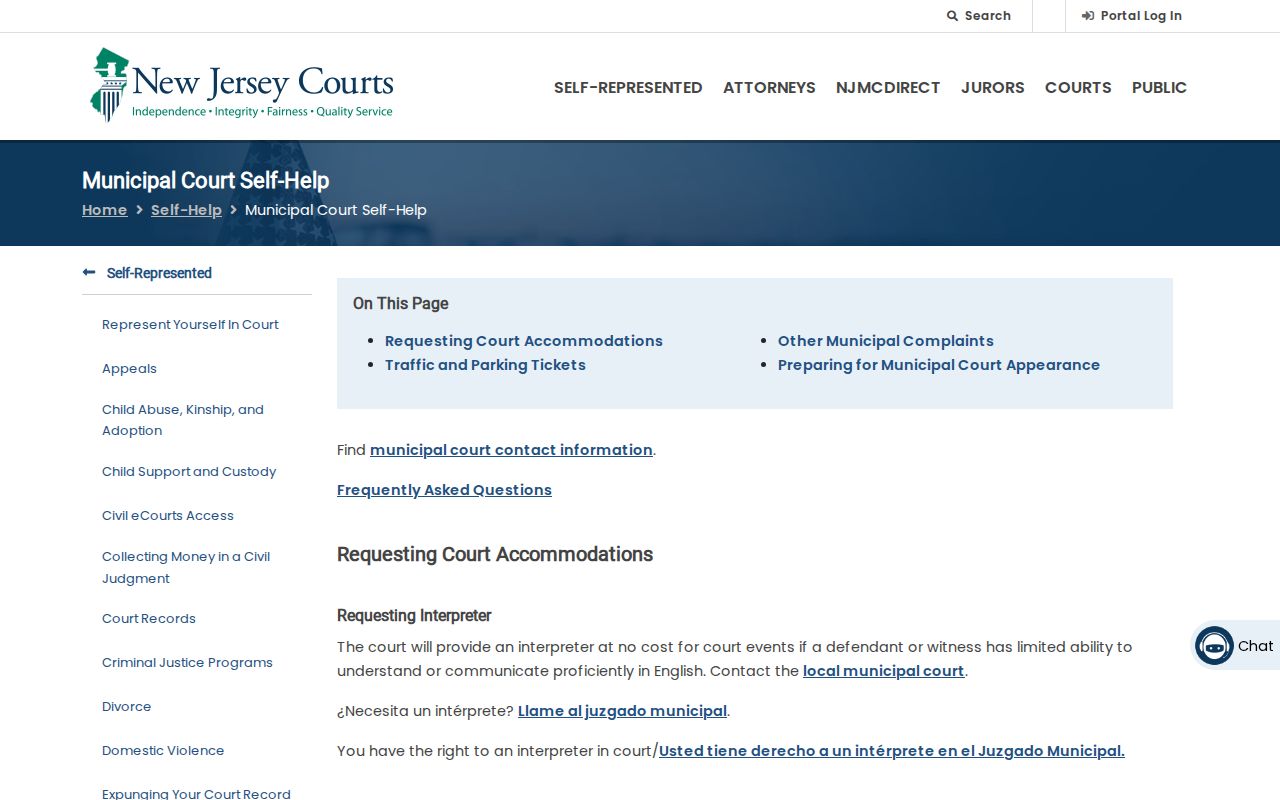
The search screen is useful only after the proper court category and identifiers have been chosen, which helps avoid drawing conclusions from a partial name match.
What a court result can contain
A docket is the court's numbered case trail. Depending on the linked search and access level, preserve these result details before asking a clerk for copies:
- Party or defendant name and the role shown in the case.
- Docket or case number, court or division, and county context.
- Case type, charge or category, or tax-parcel linkage where exposed.
- Filing, proceeding, hearing, or disposition dates shown by the index.
- Attorney, filing, proceeding, or document-list details if the portal exposes them.
- Any notice that a record is sealed, expunged, juvenile, protected, or otherwise unavailable.
Actual pleadings and exhibits are not guaranteed online. For Superior Court material, use the Judiciary request form or JEDS and give the case number, parties, record type, contact number, and the copy treatment needed. Rule 1:38 and related restrictions still control access.
Federal matters use the District of New Jersey and PACER Case Locator rather than the state portal. PACER is a paid route, with a researched 2026 rate of $0.10 per page and a usual $3 cap for most case documents; an ordinary name-result search can still be charged. Search by case number when possible, or use public-access options at a federal courthouse. Keep federal and state results in separate evidence rows.
Verify a Fort Lee Resident
To look up a Fort Lee resident accurately, build a small chain of matching facts rather than collecting many unrelated hits. The safest chain begins with a submitted name and a known address or municipality, then tests a property, court, historical, or public-affiliation record that shares another detail. A deed may anchor a party to a parcel and date, but it does not prove every current occupant. A voter status result may be useful if returned, but protected records and the unverified live field set limit what it can establish.
- Write down the full name, any alternate spelling, and the address, city, date, or relationship already known.
- Search the Fort Lee assessor or county-linked property route for an owner record, then copy the situs, mailing distinction, block, and lot without treating it as an occupant list.
- Use the official voter-status check only as it is designed, and record only the public context it returns.
- Run the matching NJ Courts category by name and Bergen County, then compare docket type, date, party role, and address clues.
- For an older family event, use the State Archives index or the NJDOH application route, observing its age, deceased-person, identity, and relationship rules.
- Docket
- The court's case number and activity trail, used to request the right file or copy.
- Index versus image
- An index identifies a record and its reference details; an image is the underlying document and may be limited, redacted, or requested separately.
- Certified copy
- A copy issued by the custodian with certification. It is different from a free search result and may require a fee or eligibility.
- Situs address
- The physical parcel address. It differs from the tax-bill mailing address when an owner receives mail elsewhere.
When a result points to the wrong person, keep the documented mismatch and stop the trail. A different middle initial, municipality, date, or party role is a reason to reject a match, not a reason to fill the gap with a guess.
Fort Lee Vital Record Limits
New Jersey vital records are not an unrestricted online name index. Fort Lee's local registrar may serve a local event, while the New Jersey Department of Health Vital Records office handles statewide issuance and the State Archives holds older series. Birth records are generally held by NJDOH from 1925 forward, and marriage and death records from 1951 forward. Older historical holdings use a different archival route.
For Fort Lee genealogy, the Department's rules generally require a birth record to be more than 80 years old and through 1925, a marriage more than 50 years old and through 1951, or a death more than 40 years old and through 1951, with the subject deceased. A recent certified copy requires the stated relationship or authority, identity materials, application, and fee. The official application controls, so do not rely on a name appearing in another record as proof of eligibility.
June 2026 payment update. NJDOH reports that the Trenton walk-in office stopped accepting cash after June 18, 2026. Its current notice also describes an application-by-3:30 p.m. timing for qualifying same-day service, with up to two hours for processing. Verify the office's current instructions before travel because payment and counter procedures can change.
Eligible requests can be routed by mail, through VitalChek, at the local registrar when it holds the event, or at the Trenton walk-in counter where the current instructions allow it. Local fees can differ. A request that is incomplete or outside the relationship rules should go back to the official eligibility instructions instead of being redirected through a name search.
For an adoptee-born-or-adopted-in-New-Jersey question, the Adoptees Birthright Act route is the official path. A birth parent may set a direct-contact, intermediary-contact, or no-contact preference. That preference belongs at the center of the search, not at the end of it.
Fort Lee Lookup Needs Narrowing
Fort Lee records sit within large Bergen County systems, so narrow a search before assuming the first similar name is right. The County Clerk's current site displays 2025 countywide activity of 87,707 registry documents processed and 671,000 registered voters at the November 4 election. Those are Bergen County figures, not Fort Lee counts. They explain why municipality, date range, party role, and block or lot are essential filters.
For a recorded document, pair a party name with Fort Lee and the date range, then add the second party or legal identifiers if the result set is broad. For a Fort Lee court index, retain the court category and docket. For a historical record, retain the custodian and coverage date. Each detail makes a resident lookup more reproducible and less likely to merge two people with the same name.
Note: Countywide volume is a reason to narrow official searches, not evidence that a particular Fort Lee person appears in a given record system.
Fort Lee OPRA Record Requests
When no online index exists, use the New Jersey Open Public Records Act, or OPRA, for a defined Fort Lee government record held by the right custodian. Fort Lee's Borough Clerk is the municipal routing point, and the Borough has an OPRA request form. A useful request names the record set, address or block and lot where relevant, date range, and preferred electronic delivery. It does not ask the Borough to search for a private person across all files.
Under the current OPRA framework, a Fort Lee custodian's response is generally due as soon as possible and no later than seven business days unless storage, archives, or another lawful circumstance applies. Electronic records are generally free apart from actual supplies, while other duplication costs may apply. OPRA does not override court rules, vital-record restrictions, protected voter information, or confidentiality programs. Court files instead follow the Judiciary request process, and historical material may be faster to reach through the State Archives, library, or historical society.
Fort Lee Resident Lookup Limits
Public records do not produce a complete directory of Fort Lee households. Guests, children, unregistered voters, utility customers, delivery recipients, and people without a recorded ownership interest may not appear in the routes described here. New Jersey also protects sensitive court, juvenile, victim, adoption, motor-vehicle, and recent vital-record information. The voter-status system is governed by N.J.S.A. 19:31-18 and 19:31-31, with additional protections for covered addresses.
The Address Confidentiality Program can provide a substitute address for qualifying people, and Daniel's Law restricts home-address and unpublished-phone disclosure for covered public-safety and judicial personnel. A missing result can therefore be a lawful protection, not a puzzle to solve through another source. If a record is wrong, contact its custodian with the record identifier and correction evidence rather than copying a disputed result elsewhere.