
Fort Lee City Directory Collections
Fort Lee historical resident research is a collection question. The strongest first stop is the Fort Lee Public Library, where staff can check local holdings and help with public computers, scanning, copying, newspapers, and databases. The public pages do not publish a Fort Lee directory year-by-year list. A second route is the New Jersey State Library's city-directory location guide, which explains shelf and microfilm codes but did not produce a Fort Lee hit in the research review. That absence matters: no Polk, telephone, reverse, or other Fort Lee run should be assumed without confirmation from the holding library.
| Collection | Years | Where Held | Access |
|---|---|---|---|
| Fort Lee Public Library local-history leads | Library established 1919; directory runs not published online | Fort Lee Public Library, 320 Main Street | Ask staff to verify titles, years, call numbers, and format |
| New Jersey State Library city-directory guide | Guide updated October 19, 2018; no confirmed Fort Lee run | New Jersey State Library guide | Use its book, microfilm, and fiche location codes |
| Englewood and Northern Valley Directory | 1900 regional example | Teaneck Public Library digital archive | Regional comparison only, not proof of a Fort Lee listing |
| Bergen County Historical Society Library materials | Historical holdings; no public Fort Lee directory run list | Bergen Community College, Hackensack | Open research hours, appointment recommended |
The practical request is specific: ask staff to check Fort Lee, Bergen County, regional Englewood or Northern Valley, telephone, reverse, criss-cross, obituary, newspaper, yearbook, and city-directory titles. Request the publisher, year, call number or location code, and whether each item is browsable, on microfilm, or held elsewhere. This turns an unverified directory shelf into a checkable inventory. Note: A regional title may cover several places, so confirm Fort Lee inside the volume before treating it as a local source.
Fort Lee Directory Year-Run Gap
The missing public run list is itself a useful research result. The New Jersey State Library guide uses routing codes for Book, Rare Book, organization microfilm, city segment on reel, city segment on fiche, and Fiche LH. It is a location aid, not proof that a title contains Fort Lee. Rare books are requested at a reference desk; microfilm and fiche have their own routes. A librarian can use the code, place, and date to determine whether a volume is available, restricted, or needs an interlibrary request.
The 1900 Englewood and Northern Valley Directory in the Teaneck archive is a good example of the regional approach, but no verified Fort Lee entry was available in the inspected material. Do not quote its visible sample as a Fort Lee resident. Instead, use it to frame a request for Northern Bergen titles and to test the place coverage printed in a volume's title pages and introduction.
Fort Lee Directory Desk and Tools
The library's reference service is valuable even when no directory has been digitized. Its collection and services include research assistance, public computers, scanning, copying, and databases, while its multilingual holdings can help a searcher compare initials, former spellings, transliterations, and community newspapers. Ask for a title by place and year, then record the exact volume details before taking notes. Library staff can also identify whether a newspaper, yearbook, obituary file, or local-history item supplies context where a directory is absent.
The Fort Lee Public Library is the local starting point for that request.
The library image reinforces the right order of work: verify the item and its date with staff, then transcribe the original listing rather than relying on a summary.
Fort Lee Historical Records in Bergen
The Bergen County Historical Society Library adds a deeper layer when a directory search reaches a dead end. Its holdings include more than 2,500 volumes, more than 200 family genealogies, manuscript envelopes, indexed photo binders, church and cemetery records, Fort Lee school material, funeral-home material, maps, newspapers, and clippings. Research is listed as free during open hours, Wednesday 12 to 5 and Thursday 10 to 3, with an appointment recommended. Non-member email or letter queries have a stated $10 charge plus small photocopy costs.
The historical society can pair a printed name with deeds, tax lists, maps, church records, or an obituary trail. Those sources corroborate a historical connection; they do not convert an unverified directory title into a confirmed Fort Lee run.
The Bergen County Historical Society Library holdings offer this county-level archival route.
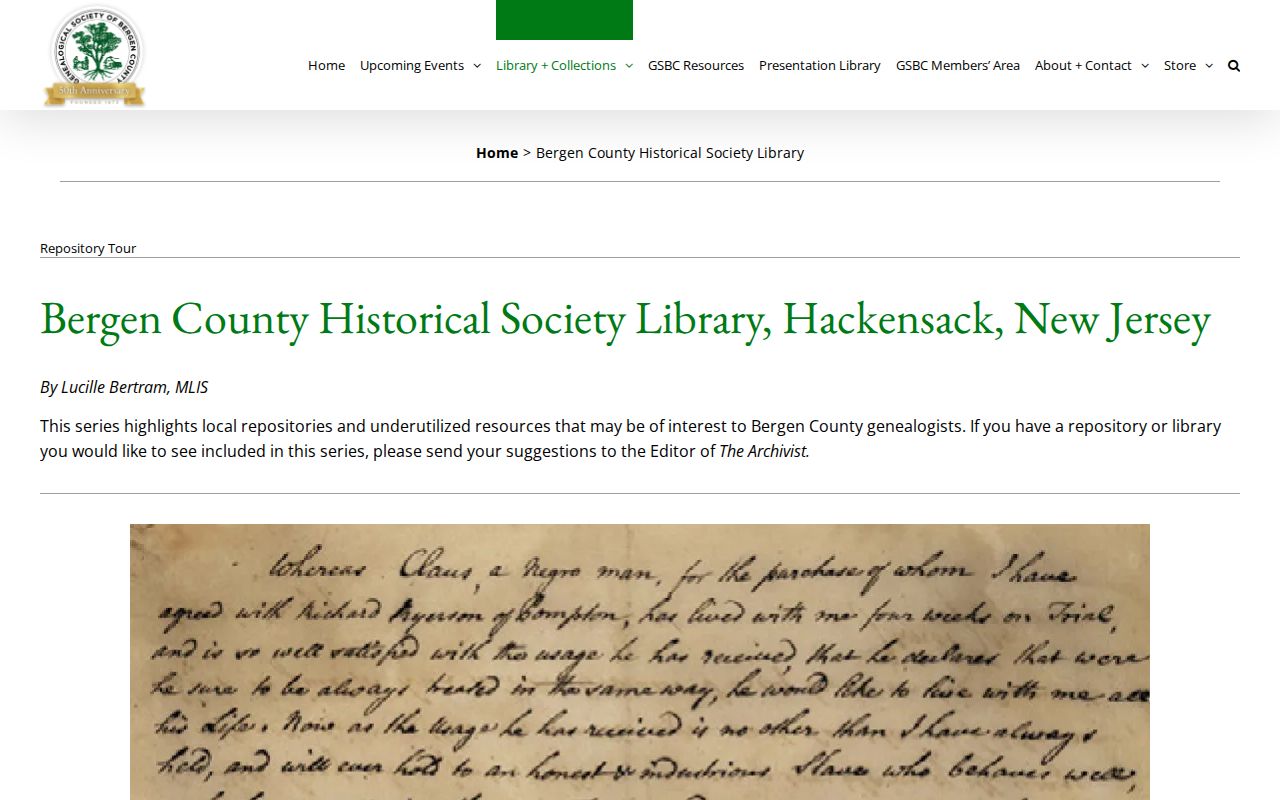
Use the collection as a companion to a directory request, particularly for school, cemetery, newspaper, map, and family-record clues that preserve the same period.
Fort Lee Directory Shelf-Code Requests
Ask for a publisher, a year, and a shelf code in the same request. The State Library guide explains that a book may be in the genealogy collection, while a rare volume is requested at reference. Organization reels are grouped by the holding library or historical society, and city segments may be on reel or fiche. This vocabulary helps a researcher ask for the object that exists, rather than a vague online search that may never display it.
The New Jersey State Library directory guide is the route for these codes. The Library of Congress also describes city, telephone, reverse, and criss-cross directories as separate formats. Each format should be requested by its own place, state, and date.
Note: A shelf code identifies a holding route, not a confirmed Fort Lee listing or a guarantee that the volume remains available.
Reading a Fort Lee Directory Entry
No authoritative Fort Lee entry was available for publication, so the safe method is to transcribe only what the actual volume prints. A historical entry may include a surname, given name or initials, spouse or household notation, address, historical occupation field, telephone exchange, business or residence classification, a cross-reference, and marks defined by that volume. Copy the page number, publisher, year, geographic scope, and abbreviation key with the name. That makes a later check possible and protects against silently modernizing an old spelling.
| Printed name | Copy surname, given name, initials, and spelling exactly as shown. |
|---|---|
| Household notation | Record a spouse, widow or widower notation only if the volume prints it. |
| Historical occupation field | Transcribe it as a directory field, together with any printed business or residence classification. |
| Street address | Keep house, unit, street, and section wording exactly as printed. |
| Marks and references | Capture ownership, boarding, telephone, page, and cross-reference marks only after reading the key. |
- Criss-cross directory
- An address-ordered directory that can move a search from a street to a printed name or business listing.
- Householder index
- A name arrangement that groups a household listing, when the volume provides one.
- Abbreviation key
- The volume's explanation of its short forms and marks. Photograph or copy it before interpreting an entry.
Note: A directory entry is a dated printed listing, not proof that every person at that address lived there at the same time.
Fort Lee Directory Names Before 1904
Fort Lee was formed on March 29, 1904 from the remaining portions of Ridgefield Township. That jurisdiction change is a key historical search term. A person or address now associated with Fort Lee may appear under Ridgefield Township, a village name, or a section label in earlier maps and regional sources. The County Clerk's historic material also identifies an 1853 Village of Taylorville map and an 1864 Pond Park at Fort Lee Village map.
- 1853: search Village of Taylorville as a Fort Lee-area map term.
- 1864: test Pond Park at Fort Lee Village in map and archival descriptions.
- 1904: shift the jurisdiction search from Ridgefield Township to Fort Lee borough records.
- 1919: include the Fort Lee Library in the local research chain.
This local records story keeps a name search from stopping at the modern borough label. It is a jurisdictional bridge, not evidence that a particular person used each name.
Fort Lee Directory Map Companions
When a historical address appears in a printed volume, the Princeton University Fort Lee Sanborn collection can place the address in its built setting. The digitized series includes 1908 sheets, 1911 Fort Lee and Coytesville-related sheets, 1923 sheets, and 1930 sheets. An index sheet helps identify the right street or site. A map can show a building footprint, construction material, use, or nearby street pattern, but it is not an occupant list.
Coytesville and Palisades are helpful search terms because they appear in the local map and catalog context. Pair a map year with the date on a directory, deed, census, or newspaper item. That comparison can show whether a street or structure existed in the period being researched without overstating who was inside it.
Note: Map labels establish a period-specific built setting, but they do not identify every historical occupant or prove a household relationship.
Trace Fort Lee Directory Households
A family-history trail is strongest when each source has a clear purpose. Use a confirmed printed listing to establish a date, then test the same spelling and address in federal census schedules, property records, maps, newspapers, and obituaries. The federal census is available through 1950, while 1960 is scheduled for release in 2032. A name that disappears may signal a move, death, a changed spelling, an unlisted household, or a change in the directory's coverage. It does not settle the question by itself.
- Find the first verified listing for the surname, initials, and address.
- Check nearby directory years, recording moves and spelling changes exactly.
- Use a reverse or criss-cross section only if staff confirms that the volume has one.
- Pair the dated listing with the nearest 1900, 1910, 1920, 1930, 1940, or 1950 census.
- Test the result against a deed, map, obituary, cemetery, or newspaper record.
For a current address or parcel question, the modern address path belongs in the Fort Lee street directory. Historical volumes work best as the dated shelf layer, not as a substitute for the current assessor or County Clerk record.
Fort Lee Directory Gaps at Archives
The New Jersey State Archives provides a different set of historical channels: older births, marriages, deaths, tax ratables, land, naturalization, probate, court, and newspaper material. Its holdings help confirm a person, place, or date when a printed volume is missing or a regional title is incomplete. Bergen naturalization material was not listed in the inspected State Archives county list, so the Bergen County Clerk and federal NARA route may be needed for that subject.
Repository gaps should remain visible in notes. No official first or last Fort Lee printed city-directory year was located, and no directory destruction event was confirmed. Ask the custodian for a narrow title, date range, format, and geographic label. That request is more likely to produce a useful answer than a broad demand for every record about a family.