
Finding Fort Lee Resident Trails
Searches work best when each record answers one small question. A property record can tie a name to a parcel. A deed can show a party to a transfer. A court index can point to a docket. The library and archives can help place a family in an earlier period. None of those sources is a complete list of everyone in town, so compare the name, address, dates, and record type before treating two references as the same person.
For a current question, start with the address or name already known. For a former household, start with the address and year. The Fort Lee residents directory is most useful as a set of official routes, not as one master file. Household members, guests, protected voters, and people with no recorded property interest may not appear in the public trail at all.
- Start with the Fort Lee Tax Assessor or county-linked property search when an address or owner name is available. Write down the situs address, block, lot, and any parcel identifier shown.
- Use the Bergen parcel viewer to check the mapped parcel and its adjacent lots. The map provides a spatial check, not a household roster.
- Search the Bergen County land-record index by party name, municipality, date, or block and lot. Record the document number and the role of each party.
- For a person or event, use the official New Jersey voter-status or court route that matches the question, then compare the returned context with the property or deed record.
- For older or unavailable material, ask the Fort Lee library, Bergen County Historical Society Library, State Archives, or the proper custodian for a narrow record set.
Note: Keep a short research log with the source, date searched, and identifier so a later request can be checked against the original record.
Fort Lee Offices Behind Resident Records
Fort Lee municipal offices handle assessment, local forms, permits, municipal-court administration, and records requests. Bergen County keeps the recorded-land system and several elections functions in Hackensack. State agencies supply the rules and statewide pathways for court, vital, and voter records. Start with the office that created the record, rather than sending a broad request to every agency.
Bergen County Clerk Land Records
One Bergen County Plaza
Hackensack, NJ 07601
201-336-7036
Fort Lee Tax Assessor
309 Main Street, Room G05
Fort Lee, NJ 07024
201-592-3500 x1506
Bergen Board of Elections
One Bergen County Plaza, Room 310
Hackensack, NJ
201-336-6225
The County Clerk says its record holdings include land records, historic documents, naturalization records, elections support, notary oaths, and veteran or service cards. Its online land documents begin January 1, 1970. Earlier material needs a county-counter, archive, library, or historical-society route. The County Clerk's official page is a useful starting point when the precise unit is unclear.
Here is the County Clerk source used for that routing information. Its scale is a reminder to narrow a name search by municipality, date, party role, and block or lot when possible.
Bergen County Clerk office information identifies the county records custodian and its land-record services.
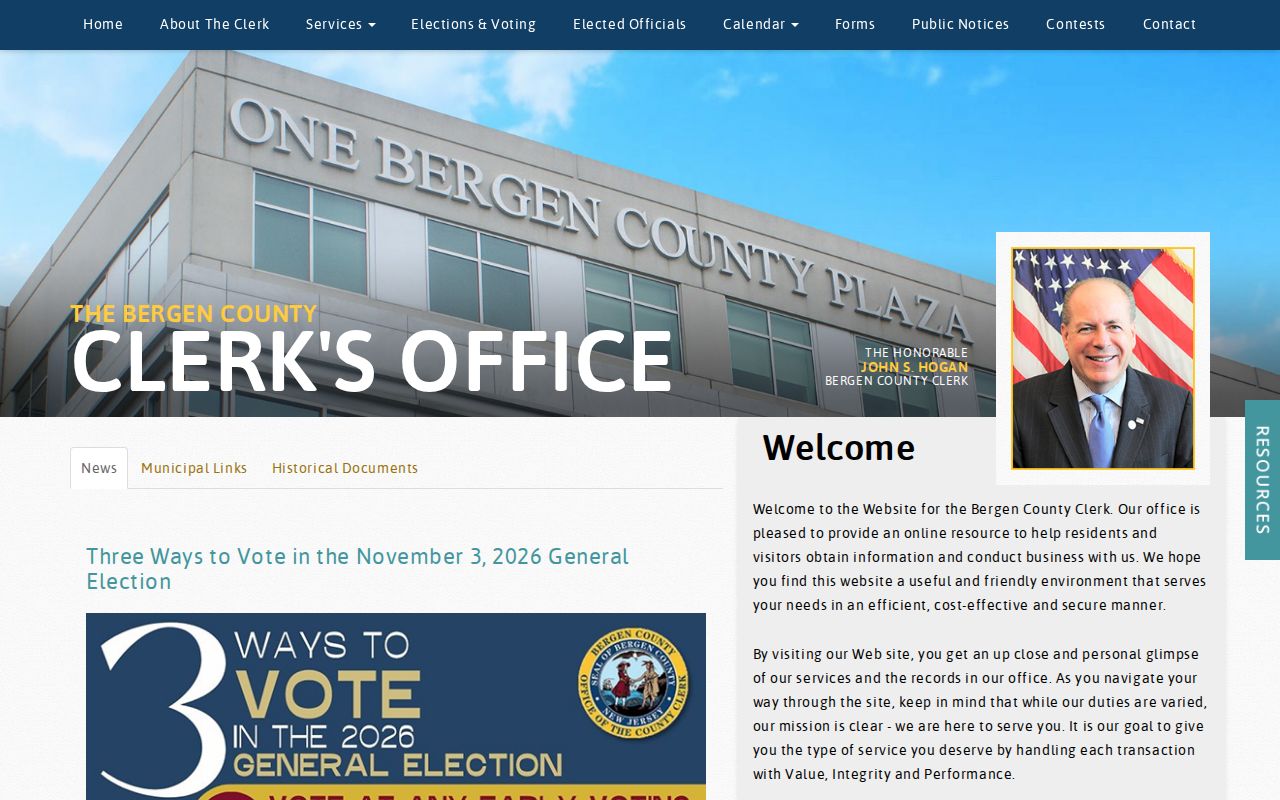
The Clerk route is especially useful when a property clue needs a recorded-document reference rather than a general name match.
Fort Lee Parcel Clues Have Two Addresses
The property route begins with the assessor and county-linked search, then uses a map and land index to check the trail. A situs address is the physical parcel address. A tax mailing address tells the government where a bill is sent. Those addresses can be different, and neither field establishes that every person at the physical site lives there. The parcel's block and lot are often more stable than a street spelling.
The county-linked New Jersey property-search page is the public entry point captured for the Fort Lee property trail. Its exact live Fort Lee controls were not fully exposed during research, so treat the labels below as a verified search plan and confirm the current display before relying on a result.
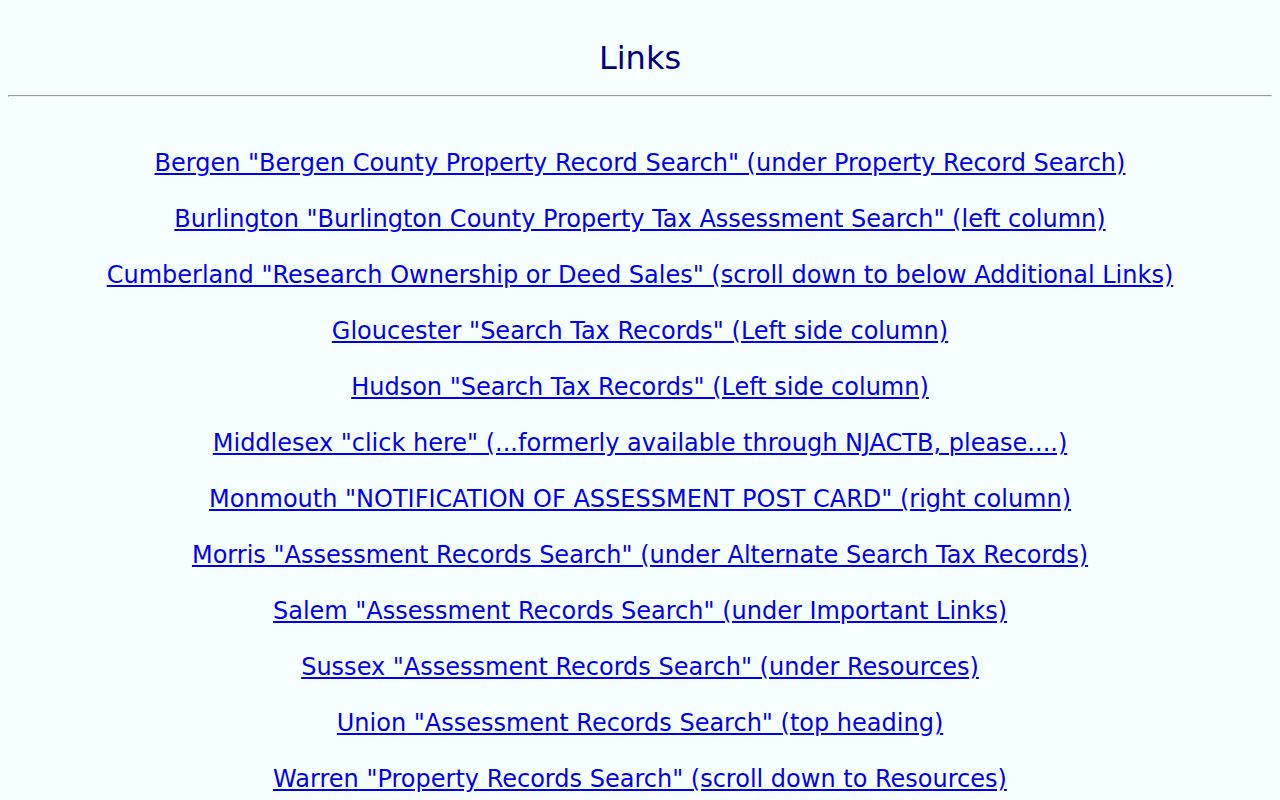
When the property screen returns a parcel, carry its legal identifiers to the GIS viewer and recorded-land index instead of assuming a mailing field reflects occupancy.
| Fort Lee property clue | How to use it | Important limit |
|---|---|---|
| Owner name | Try surname, initials, and entity variations | Shows an owner of record, not every resident |
| Situs address | Find the physical parcel and ask for address-specific municipal records | Street spelling and numbering must match the portal |
| Block and lot | Bridge an assessor or GIS result to a deed search | They identify land, not a household |
| PAMS_PIN | Use the county composite parcel reference where returned | Qualified interests can create duplicate pins |
- Parcel
- A mapped tract of land used in assessment and tax administration.
- Situs address
- The physical address of that parcel, distinct from a mailing address.
- Block and lot
- Legal tax-map identifiers that connect mapping, assessment, and recorded land records.
- Index
- A finding tool that points to a record; it is not always the underlying document image.
Fort Lee Deed Names Need Context
Bergen's land-record portal offers Advanced SearchNG and BrowserView Web Search. BrowserView is the fallback when the advanced option will not launch. The official help advises spelling variants, multiple-name searching, ALL or ANY logic, and paired Party Name and Second Party Name searches. Results list each party separately. F2 opens document detail and F5 opens an image where available.
For a Fort Lee residents directory search, pair the party name with Fort Lee, a date range, document type, block, or lot. A grantor is the party transferring an interest; a grantee receives it. A mortgage, lien, release, or other filing may include a name but does not prove that the person currently lives at the parcel. The public online document range starts January 1, 1970, so the older chain moves to deed books and repositories.
| Bergen land-record field | Search purpose | Fort Lee use |
|---|---|---|
| Party Name | Find an indexed party with prefix matching | Start with surname variants |
| Second Party Name | Narrow a relationship | Test paired transfer parties |
| Town / Municipality | Limit the place | Select Fort Lee when available |
| Date From / Date To | Restrict recorded dates | Separate recent and historic research |
| Block / Lot | Use legal parcel keys | Connect a parcel to documents |
Note: The portal's document-type tree and live export behavior were not captured, so verify those options in the current browser session.
Fort Lee Voter Status Is Narrow
The official New Jersey registration-status endpoint is a limited confirmation channel. Research could not inspect its live fields because the endpoint returned a 403 response to automated access. Do not infer a last-name, birth-date, or municipality requirement from the statewide registry law. Use the official tool as it currently appears and record only what it lawfully returns.
New Jersey's voter-status check is the official source for that narrow step. The registry law has broader data fields, but protected addresses, signatures, sensitive identifiers, and confidential information are not a public lookup result. Voting history records participation, not ballot choices. The County's public pages did not supply a current full-file order form, fee, or delivery specification.
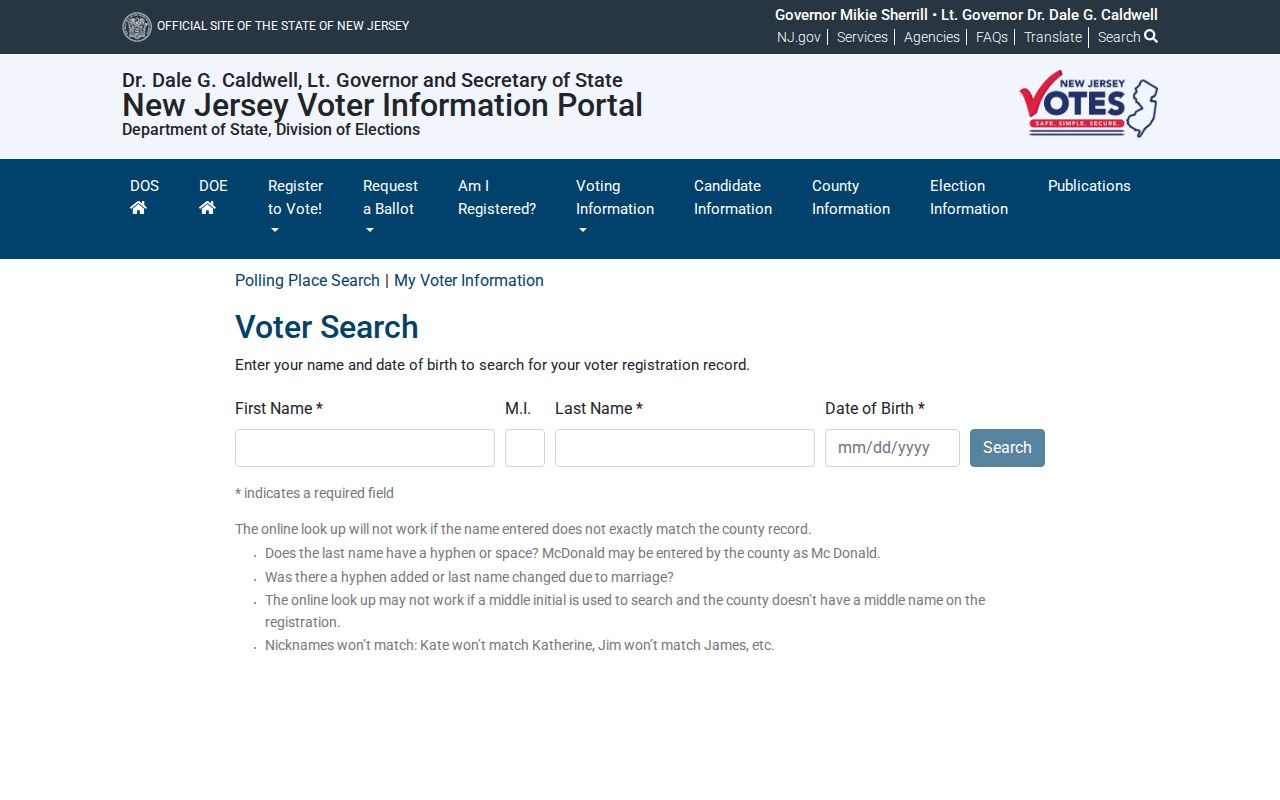
The screenshot identifies the official status route, while the current tool itself remains the authority for its fields and any result.
Current Fort Lee Resident Sources
Current sources identify different relationships. Assessment and deed records identify property and recorded parties. Court records identify a party to a particular case. State licensing and business filings can confirm public affiliations. Borough staff and community directories identify public offices or organizations. The columns below separate those uses so a reader does not mistake a name in one category for a present household list.
| Fort Lee source | What it can identify | Custodian | Access route |
|---|---|---|---|
| Assessment/property record | Owner of record, parcel, situs, tax-mailing context | Fort Lee Tax Assessor | Property search, counter, or specific request |
| Recorded land index | Deed, mortgage, lien, or release parties | Bergen County Clerk | Free online index from 1970 forward |
| Voter status | A matching registration status if returned | New Jersey elections | Official status tool and elections custodian |
| Court index | Parties, docket, category, and public case context | New Jersey Courts | Find a Case and clerk request routes |
| Public organization directory | Named civic or business contacts | Borough or Chamber | Public category, name, or alphabet filters |
When the question becomes whether several records refer to one person, the Fort Lee resident lookup route focuses on matching names, dates, places, and record types. A lookup needs independent confirmation when names are common or an address has changed.
Fort Lee Court Searches Start by Category
New Jersey Courts Find a Case is a gateway to separate civil, criminal, judgment-lien, tax, and municipal search routes. It is not one universal resident lookup. Use the category that fits the record, then compare the party name, county, docket, date, and role. A court index may expose case placement, parties, filings or proceedings, and disposition-level information, while fuller files can require a clerk request and an allowed access route.
NJ Courts Find a Case supplies the statewide category links used for Fort Lee matters. Fort Lee Municipal Court directs ticket and complaint matters to NJMCDirect when the necessary identifiers are available. Sealed, expunged, juvenile, adoption, protected-victim, and other confidential material is not a general public search.
Use a case number or a narrowed party search whenever possible, since a name result alone does not confirm identity or current residence.
Fort Lee Began Outside Its Present Name
Fort Lee was formed on March 29, 1904 from the remaining portions of Ridgefield Township. That jurisdiction change matters when a family, parcel, or map predates the borough. Older material may be cataloged under Ridgefield Township, a village label, or a local section name rather than under Fort Lee. The County Clerk's historic holdings also name a Village of Taylorville map filed in 1853 and a Pond Park at Fort Lee Village map filed in 1864.
This records history is a practical search tip, not a substitute for a document. Search the current and historic place names, retain the spelling used by the original item, and use block, lot, map, deed, or census context to decide whether two geographic references concern the same place. Princeton's Fort Lee Sanborn series covers 1908, 1911, 1923, and 1930, including catalog contexts for Coytesville and Palisades.
Fort Lee Records Have Privacy Boundaries
A public record can be useful without proving a full personal profile. Property-owner and tax-mailing fields do not show every occupant. A voter-status return is not a street-wide roster. Court and vital records have their own access rules. The New Jersey Address Confidentiality Program, Daniel's Law, protected voter provisions, court confidentiality rules, and vital-record eligibility rules can remove or restrict information that might otherwise seem searchable.
| Official record route | Strength | Reason to verify |
|---|---|---|
| Custodian index or record | Shows the record type and its stated scope | May be historic, partial, redacted, or limited to a legal relationship |
| Compiled commercial people-finder category | May offer a quick lead | Identity merging, stale information, and opt-out issues can occur |
| Library or archive collection | Supplies historical context and local holdings | Catalog gaps and historic spellings need cross-checking |
Fort Lee OPRA Requests Need Detail
The New Jersey Open Public Records Act, N.J.S.A. 47:1A-1 et seq., is an offline route when an eligible municipal record has no public search. It does not turn an agency into a general people-search service and it does not override privacy exemptions, court rules, protected addresses, or vital-record restrictions. The useful request names the record type, date range, address or block and lot, and preferred electronic delivery, while allowing legally required redactions.
Fort Lee's OPRA request form routes requests through the Borough Clerk. The Government Records Council says an ordinary request is generally due as soon as possible and no later than seven business days, subject to lawful exceptions such as archived material. A denial or nonresponse can be challenged through the GRC or Superior Court under the applicable procedures.
- Name the custodian and a defined record, such as a permit record for one address or a specific meeting record.
- Include dates, a document number, or block and lot if those are known.
- Ask for electronic delivery where a record exists electronically and retain the request acknowledgment.
Historical Fort Lee Resident Directories
Fort Lee historical work is a collection search. The public library is the practical first desk for local directories, newspapers, yearbooks, and database help. Its public pages do not list a verified year-by-year Fort Lee directory run, so ask staff for a specific check of Fort Lee, Bergen County, regional Englewood or Northern Valley, telephone, reverse, criss-cross, obituary, newspaper, and city-directory titles. Request the publisher, year, call number or location code, and whether each item is browsable or on microfilm.
Fort Lee Public Library supplies the local reference route and public research services. The New Jersey State Library's directory guide explains book, rare-book, reel, fiche, and local-history shelf codes, while the Bergen County Historical Society Library holds manuscripts, maps, tax lists, church and cemetery records, Fort Lee school records, newspaper materials, and funeral-home material. The full historical shelf and tracing method appear in the Fort Lee city directory collections.
Fort Lee Vital Records Follow Eligibility Rules
Recent vital certificates are not a public online name index. Fort Lee's local registrar can handle local service, while the New Jersey Department of Health is the statewide route and the State Archives holds older series. For genealogy, New Jersey generally describes births older than 80 years through 1925, marriages older than 50 years through 1951, and deaths older than 40 years through 1951 as eligible only when the subject is deceased. The current application instructions control the practical request.
New Jersey Vital Records describes state, local, mail, walk-in, and VitalChek channels. The agency said cash would no longer be accepted at the Trenton walk-in office after June 18, 2026, so confirm current payment and timing before traveling.
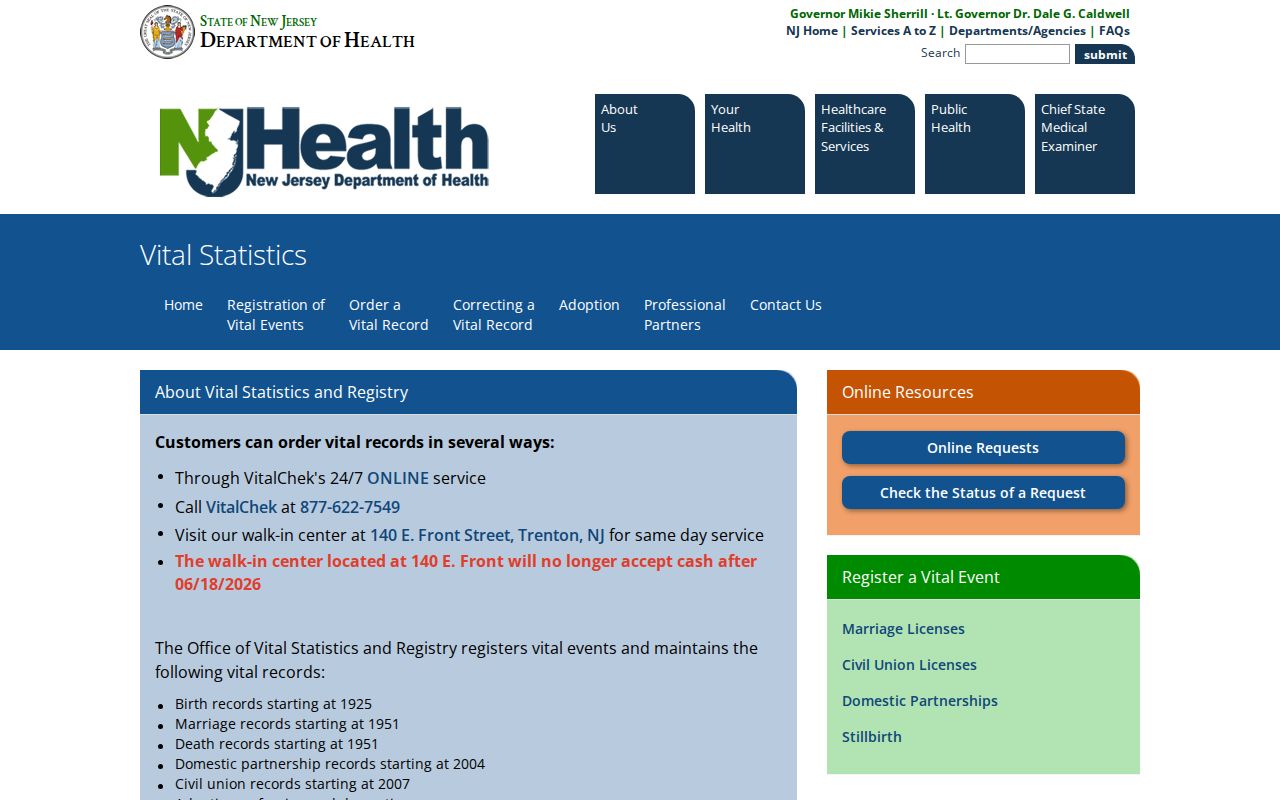
The vital-records route can corroborate an eligible historical event, but it should never be treated as a general resident search.